Schedule
All lecture Powerpoints can be found in this class Google Drive.
Week One: Introductions
Monday, September 9 (modified schedule: 9:50-10:35am)
Topic: syllabus and class website review
Please do the following:
- Complete the Tell Me About Yourself! Google Form
- Log in the class website (linked on landing page) and familiarize yourself with the dashboard and how to make a blog post
Wednesday, September 11
Topics: Native geography (native-land.ca), terminology, primary v. secondary sources, thinking like a historian overview
Discuss: Quick primer: “Teaching & Learning about Native Americans,” and A Model of Historical Thinking and tips for terminology
Friday, September 13
Topics: The end of treaty making (1871) and federal Indian policy in the Reconstruction era
Discuss: There,There p. 3-44
Blog post 1 (due Sunday by Midnight): Write a post introducing yourself. What are your academic and other interests? What do you look forward to learning about in this course? Additionally, reflect on your experience with learning about Native American history (from other history classes, contemporary news, popular culture, etc.).

Week Two: Resistance Across the West
Monday, September 16
Topics: The Modoc War (1872-1873), Apache resistance, and the Red River War (1874-1875)
Discuss: Valentine’s Day Treaty with the Modoc (1864), Winema Riddle’s Pension Certificate (1891), Statement of Geronimo (1886)
Wednesday, September 18
Topics: Pahá-Sápa, Custer’s 1874 expedition, and the Battle of Greasy Grass (1876)
Discuss: Kicking Bear, The Battle of Little Big Horn (c. 1896) (click image and zoom) and F. Otto Becker, Custer’s Last Fight (c. 1896-1920)
Optional: Tȟatȟáŋka Waŋžíla (Henry Oscar One Bull), Custer’s War, (c. 1900)
Friday, September 20
Topics: Hin-mah-too-yah-lat-kekt (Chief Joseph) and the Nez Perce
Discuss: There ,There, p. 45-78: “Opal Viola Bear Shield” and “Edwin Black”
Blog post 2 (due Sunday by Midnight): The Battle of Greasy Grass, also known as the Battle of Little Big Horn or “Custer’s Last Stand” has figured prominently in American memory. Reflect on why you think that this battle, which ended in a major Lakota, Northern Cheyenne, and Arapaho victory, influenced the tide of Native resistance in the West. Compare this event to other acts of resistance elsewhere; what is the “big picture” of Native resistance at this time? Remember to discuss and analyze at least one source in your response.

Week Three: Policies of Confinement + Assimilation
Monday, September 23
Topics: Railroads, reservations, and the extermination of bison
Discuss: Homecoming: Buffalo Return to Indigenous Lands (19 min video) and “Big Medicine’s long journey home”
Wednesday, September 25
Topics: The Dawes Act (1887) and Boarding Schools
Discuss: “Sioux boys as they arrived at Carlisle” (photo), “Sioux boys 3 years after arrival at Carlisle” (photo), “A 1912 weekly outline and lesson plan for the Upper Lake Day School for Native Americans in California” and “A letter from the Commissioner of Indian Affairs (the “long hair” letter) about the way in which Indian people should dress and act, 1902“
Friday, September 27
Topics: Boarding Schools part II: NAGPRA, repatriation movements, and remembering
Discuss: There, There p. 81-117; and “Why Don’t Indigenous Children Buried at Carlisle and Other Former Indian Boarding Schools Qualify for Repatriation Under NAGPRA?” and Carlisle Repatriation Updates
Blog post 3 (due Sunday by Midnight): The themes of this week centered on the myriad efforts to confine and assimilate Native Americans. Reflect on the topic(s) that resonated most with you—what aspects of these policies or actions caught your attention, and why do you think you responded this way? Consider not only the immediate effects on Native American communities but also legacies of these policies and how communities are responding today. Remember to discuss and analyze at least one source in your response.

Week Four: “The Buffalo are Coming”: The Ghost Dance Movement & the 1890s
Monday, September 30
Topics: Wavoka’s vision and the Ghost Dance ceremony
Discuss: Wovoka’s Message and James Mooney’s recordings of Ghost Dance Songs, and “Indians Not Ready to Fight,” Indianapolis Journal, 1890.
Wednesday, October 2
Topics: Sitȟáŋka tȟaóyate kiŋ wičhákasotapi (“Where Big Foot’s people were wiped out” / the Wounded Knee Massacre) (1890) and rethinking the “closing” of the frontier
Discuss: Lakota accounts from the Commissioner of Indian Affairs Report (1891), and “‘In Memory of the Chief Big Foot Massacre”: The Wounded Knee Survivors and the Politics of Memory,” WHQ (2015) and “The Significance of the Frontier in American History” (1893)
Friday, October 4
Topics: Kānaka Maoli:
The Kingdom of Hawai’i, Annexation (1898), and Sovereignty Movements
Discuss: There, There p. 118-155 (Orvil Red Feather through Jacquie Red Feather; optional: browse the documents related to protesting Hawaiian Annexation
Blog post 4 (due Sunday by Midnight): Frederick Jackson Turner remarked that by 1890, the Superintendent of the Census deemed that the “frontier of settlement… can not… any longer have a place in the census reports.” The “frontier thesis” as Turner’s speech became known, had a profound impact on the history of the American West for decades to come. Reflect on how this also affected the treatment of Native American history, especially given that the Wounded Knee Massacre also happened in 1890. For many students in history courses, Wounded Knee is the last time that Native Americans are mentioned. How can we, as historians, begin to look beyond the problem of “frontier” history? Remember to discuss and analyze at least one source in your response.

Week Five: The Dawn of the [Native] American Century
Monday, October 7
Topics: The making of the U.S.-Canadian and U.S.-Mexican borders and imperialism at the turn of the twentieth century
Discuss: Listen to Getting Curious Podcast, “What’s The Cold, Hard Truth About Ice In Hawaiʻi? with Hiʻilei Julia Kawehipuaakahaopulani Hobart” (2022 – 60 min) and “Why a Native tribe in Arizona has drafted a roadmap to expedite border crossings (6 min video)” and “Iroquois lacrosse team gives up chance at championship over passports.”
Wednesday, October 9
Topics: National parks, Native Lands: Native Dispossession and Fighting for Treaty Rights into the Twentieth Century
Discuss: Please bring your laptop to class (I will have a few extra just in case!); 1971 “Keep America Beautiful” Ad (1 min video)
In-class activity: Take a Google Earth virtual field trip!
Friday, October 11
No Class
Blog post 5 (due Sunday by Midnight): The twentieth century, often dubbed the “American century” is marked by the United States entering a new era of imperialism (ushered by the Spanish-American War). Reflect on the topics this week and their centrality in the creation of borders and boundaries, as well as how U.S. settler colonialism fed into imperialism. You may also approach these topics from a racial, gendered, economic, or environmental perspective. Remember to discuss and analyze at least one source in your response.

Week Six: The Fight for Citizenship and Sovereignty
Monday, October 14
Topics: Native Americans and WWI, code talkers, and the Citizenship Acts (1919, 1924)
Discuss: “Letter from the Commanding Officer of the 142nd Infantry to the Commanding General of the 36th Division, stating how messages would be transmitted” (1919) and “List of terms used by Choctaw codetalkers” (1919) and “Excerpt from a Department of the Interior report that explains Indian citizenship (1952)“
Wednesday, October 16
Fall Institute Day — No Class
Friday, October 18
Topics: Ni Okašką (Osage Nation) and U.S. v. Ramsey (1926)
Discuss: There, There p. 159-225 (Opal Victoria Bear Shield through Thomas Frank)
Blog post 6 (due Sunday by Midnight): This week centers on the tension between the themes of citizenship and sovereignty. Reflect on the impact of WWI on Native American citizenship, as well as the continuity of issues related to Native sovereignty in the postwar era. Remember to discuss and analyze at least one source in your response.

Week Seven: The Indian New Deal
Monday, October 21
Topics: A “New Deal” for all?: The Meriam Report (1928) and the Indian Reorganization Act (1934)
Discuss: “Letter to John Collier” and “The CCC Indian Division” and browse issues of Indians at Work (1933-1945).
Wednesday, October 23
No Class, work on film review project
Friday, October 25
No Class, work on film review project
No weekly blog post; complete the film review project. Due Sunday by 11:59pm

Week Eight: The Termination Era (1940s-1960s)
Monday, October 28
Topics: U.S. Exploitation of Native Lands, Resources, and Energy in the WWII era
Discuss: Marsha Weiseger, “Gendered Injustice: Navajo Livestock Reduction in the New Deal Era,” WHQ 2007 and Ian Zabarte, “A message from the most bombed nation on earth,” 2020.
Wednesday, October 30
Topics: The Indian Claims Commission (ICC) (1946), Termination policy and Relocation (1953-1970)
Discuss: House Concurrent Resolution 108 (1953) and “Reaffirmed Statement on Indian Policy” by the National Congress of American Indians (1959)
Friday, November 1
Topics: Reversing termination: Restoring recognition and the American Indian Movement (AIM) (1968)
Discuss: There, There p. 229-260 (Orvil Red Feather through Edwin Black); and “1989 – American Indian Activist Russell Means testifies at Senate Hearing” (18 min video)
Blog post 7 (due Sunday by Midnight): After WWII, U.S. policies towards Native Americans underwent a drastic shift that aimed to dismantle Native lands, resources, and governance. This week’s readings shed light on this period of exploitation and loss, all while ushering a new era of modernization, growth, and affluence for other Americans. Reflect on this disparity and the experiences of Native peoples in the post-WWII era. Consider the racial, gendered, and ecological scope of termination and its legacies. Remember to discuss and analyze at least one source in your response.
Week Nine: A New Wave of Native Activism
Monday, November 4
Topics: The Occupation of Alcatraz (1969), The Trail of Broken Treaties and the Occupation of the Bureau of Indian Affairs in Washington, DC (1972)
Discuss: Browse the Documents from the Museum Collections at Alcatraz Island (advance using the blue key icon at bottom of screen) and “The 1969 Occupation of Alcatraz Was a Catalyst for Indigenous Activism” (2024 -13.5 min video)
Wednesday, November 6
Topics: The Wounded Knee Occupation (1973) and Leonard Peltier’s trial
Discuss: Watch Newsnight Minnesota on Peltier, 1996 (4.5 min video) and “I am still here”: Leonard Peltier’s Letter to Supporters (2023) and “Indigenous activist Leonard Peltier denied parole for 1975 killings of 2 FBI agents,” NPR, 2024.
Friday, November 8 — Moved to Monday, November 11!
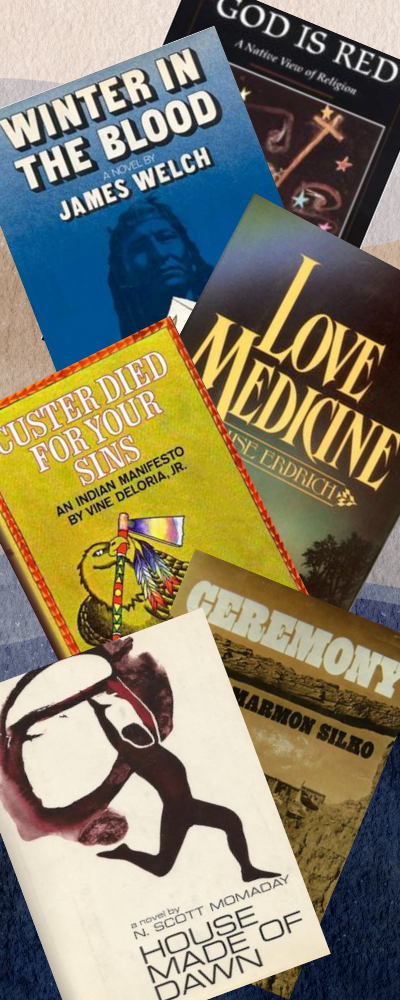
Topics: A Native American renaissance: literary, musical, and artistic expression
Discuss: There, There p. 261-290 (Thomas Frank to end); Charlie Hill’s (Oneida) standup routine on The Richard Pryor Show (1977) and browse the Spotify Playlist of Native music 1960s-present
Blog post Week 9 (due MONDAY by Midnight): For this week, write a reflection about any of the themes, topics, people, or events discussed from this week (Monday and Wednesday’s assigned content). Remember to discuss and analyze at least one source in your response.


Week Ten: Contemporary Resistance and the Future
Monday, November 11
Topics: Idle No More, the Dakota Access Pipeline Protests (2016), Missing and Murdered Indigenous Women (MMIW), and #LandBack
Discuss: (From Friday): There, There p. 261-290 (Thomas Frank to end); Charlie Hill’s (Oneida) standup routine on The Richard Pryor Show (1977) and browse the Spotify Playlist of Native music 1960s-present
Audra Simpson, “The State is a Man: Theresa Spence, Loretta Saunders, and the Gender of Settler Sovereignty,” Theory & event, 2016-10, Vol.19 (4), 2016 and “Why Native Hawaiians Protesting Giant Telescope on Mauna Kea Aren’t Going Anywhere” (2019 – 10 min video) and “What Really Happened at Standing Rock | I Was There” (2021 – 13 min video).
Wednesday, November 13
Reading Day, No Class
Friday, November 15
No Class
No weekly blog post; submit the Final Research Project by Sunday, November 17 at 11:59pm CT.