“The settler makes history and is conscious of making it.” – Frantz Fanon, The Wretched of the Earth
Despite the quote by above being written by decolonial thinker Frantz Fanon in the context of the Algerian Revolt of 1961 against the French, it still rings true for the Indigenous American reality in 1876 at the Battle of Greasy Grass. The revolt of Indigenous Americans (I use revolt purposefully and rhetorically as it was truly a challenge to the settler state) during the battle was one of the most if not most impactful winnings for the Indigenous as it marks the defeat of a technological superior military power on the day of the centennial of the United States, a defeat humiliating at a time of celebration and patriotism. For many Indigenous Americans, the revolt at Southeastern Montana had became an impetus, an ideal for the Indigenous to be inspired by for future revolutions such as more contemporary movements like the American Indian Movement. Of course, however, for the settlers, it is not seen this way for obvious reasons. While for the Indigenous, the Battle of Greasy Grass was known as just as the Battle of Greasy Grass, to the settlers, it was known as Custer’s Last Stand. Such a title is purposeful as for one, it obfuscates the very reasoning for the battle, of settler displacement and treaty breaking.
While there were conflicts pre the 1868 treaty of Fort Laramie, it was not until the 1874 Black Hills expedition and the 1875 negotiations to let settlers move into their territory in which the Indigenous peoples of the land had realized there was no choice but to take up arms. So came the 1876 revolt of the Indigenous. For the settlers though, the battle was a massacre, just unjustifiable savagery on part of the Indigenous and only their great settler hero, Colonel George Armstrong Custer stood in their way. This narrative was extremely mainstream among the settlers as can be seen with the art work published post battle of 1876.
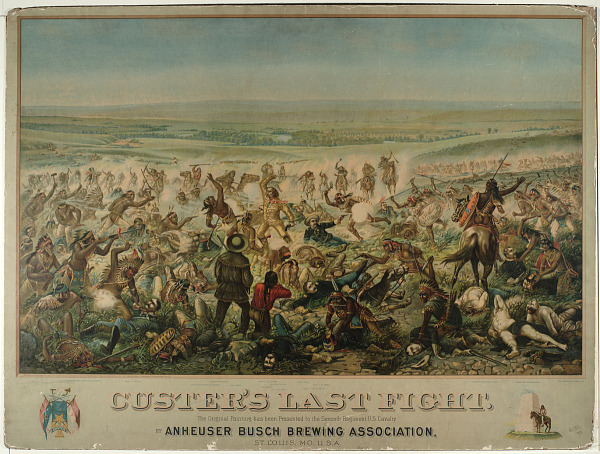
As can be seen in the picture, there stands Colonel Custer with his long wavy hair being blown by the wind with his sword standing tall with the brutal savage Indigenous castrating and beheading his men surrounding him.
The painting is one of many illustrating Custer as this so-called hero taking his stand against the violent Indigenous. How else would white European settlers be able to cope with this humiliating defeat on the centennial of America?
The settler colonizer when making history is never unchallenged, however. They are always challenged by their colonized counterpart whether it be through violent revolts or through literary and artistic means.

One Bull illustrates a purely revolutionary image of the Battle of Greasy Grass. We are given an image not revering the colonizer, but a reverence towards the colonized of their fervor for liberation. On the bottom right, we are shown the army of Custer retreating as can be seen with them facing back whilst their horses ride away. In the middle can be shown the faceless dead settler soldiers.
While we continue to live under settler-colonialism, history will always be written by the settlers and for the settlers. But so long as those narratives exist, so will the stories of the Indigenous and the oppressed continue to exist until liberation.